
CRISPR Base & Prime Editing
Aldevron, in partnership with IDT, offers adenine base editor (ABE) mRNAs and Prime Editing (PE) Ultra mRNA designed to meet the demands of modern genome editing workflows.
Which editing approach is right for your application?
CRISPR-Cas9 editing, Base Editing, and Prime Editing represent complementary genome editing technologies, each using a distinct mechanism to introduce genetic changes. The table below provides an overview of the key steps in the editing process underlying each approach.
CRISPR-Cas9 Editing
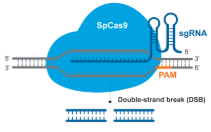
Mechanism:
- Target recognition: Cas9 guided by gRNA binds to target DNA
- DNA cleavage: Cas9 introduces a double-stranded break
- Cellular Repair: The break is repaired by pathways including NHEJ and HDR
Base Editing
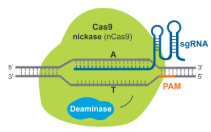
Mechanism:
- Target recognition: nCas9 guided by gRNA binds to the target DNA
- Deamination: The deaminase converts the target base within the editing window
- DNA nicking: nCas9 nicks the non-edited DNA strand to stimulate repair
- Base conversion: Cellular repair replaces the deaminated base, creating a precision conversion
Prime Editing
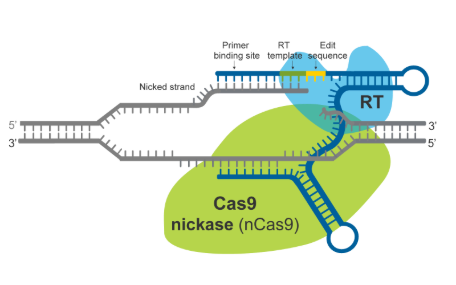
Mechanism:
- Target recognition: Prime editor guided by pegRNA binds to the target DNA
- Nicking: Cas9 nickase cuts a single strand of the DNA
- Reverse transcription: The RT copies the edit encoded in the pegRNA RT template and incorporates it into the target DNA
- Repair: Edited strand is incorporated. The unedited strand is repaired to match new sequence
Editing approach comparison
| Feature | CRISPR-Cas9 Editing | Base Editing | Prime Editing |
| Double-strand DNA break required | Yes | No | No |
| Donor DNA template required | Often required for precise insertions | No | No |
| Supported edit types | Gene knockouts, insertions, and HDR-mediated modifications | A→G base conversions | All base substitutions, small insertions, and deletions |
| Editing precision | Broad editing outcomes dependent on DNA repair pathways | Highly precise single-base changes | Precise sequence modifications with broad editing flexibility |
| Genotoxicity considerations | Higher due to double-strand break formation | Lower due to absence of double-strand breaks | Lower due to absence of double-strand breaks |
| Typical applications | Gene knockout, gene insertion, functional genomics | Precise nucleotide correction, disease modeling, translational research | Disease mutation correction, precision engineering, translational research |
| Design complexity | Relatively straightforward | Moderate | More complex due to pegRNA design requirements |
| Best used when | Creating knockouts or introducing larger insertions | Correcting specific point mutations with high precision | Installing precise substitutions, insertions, or deletions without donor DNA |