
CRISPR Base Editing Solutions
Precise and efficient adenine base editing without double-stranded breaks
Designed for precise genome editing
Aldevron, in partnership with IDT, offers adenine base editor (ABE) mRNAs designed to meet the demands of modern genome editing workflows.
Base editing enables targeted nucleotide conversion without creating double-strand DNA breaks or requiring donor DNA templates. Designed for researchers developing next-generation cell and gene therapies, Aldevron base editing solutions combine stocked ABE mRNAs, highly modified guide RNAs, targeting flexibility through multiple PAM options, and technical support to help streamline precision editing workflows.
Performance Highlights
- Enable precise A-to-G genome edits without double-strand DNA breaks, helping reduce genotoxicity concerns in translational research applications
- Expand your editable target regions with multiple PAM-compatible editor variants and high-specificity options designed to address challenging genomic loci.
- ABE mRNA screening kit to determine the best approach for your experiments
- Improve editing success with stocked base editor mRNAs, optimized sgRNA XT chemistry, and expert support
Looking for cGMP versions of Adenine Base Editor mRNA? Contact us directly by filling out the form and a member of our team will reach out to you.
Available Formats (Research Grade Only)
Base Editor mRNA enzymes
| Item No | Description | Purchase Option |
| 3840-0020 | ABE8e nCas9 mRNA, RG, 20 µg | Buy Now |
| 3840-0100 | ABE8e nCas9 mRNA, RG, 100 µg | Buy Now |
| 3840-1 | ABE8e nCas9 mRNA, RG, 1 mg | Buy Now |
| 3841-0020 | ABE8e nSpG mRNA, RG, 20 µg | Buy Now |
| 3841-0100 | ABE8e nSpG mRNA, RG, 100 µg | Buy Now |
| 3841-1 | ABE8e nSpG mRNA, RG, 1 mg | Buy Now |
| 3842-0020 | ABE8e nSPRY mRNA, RG, 20 µg | Buy Now |
| 3842-0100 | ABE8e nSPRY mRNA, RG, 100 µg | Buy Now |
| 3842-1 | ABE8e nSPRY mRNA, RG, 1 mg | Buy Now |
| 3843-0020 | ABE8e-V106W nCas9 mRNA, RG, 20 µg | Buy Now |
| 3843-0100 | ABE8e-V106W nCas9 mRNA, RG, 100 µg | Buy Now |
| 3843-1 | ABE8e-V106W nCas9 mRNA, RG, 1 mg | Buy Now |
| 3844-0020 | ABE8e-V106W nSpG mRNA, RG, 20 µg | Buy Now |
| 3844-0100 | ABE8e-V106W nSpG mRNA, RG, 100 µg | Buy Now |
| 3844-1 | ABE8e-V106W nSpG mRNA, RG, 1 mg | Buy Now |
| 3845-0020 | ABE8e-V106W nSPRY mRNA, RG, 20 µg | Buy Now |
| 3845-0100 | ABE8e-V106W nSPRY mRNA, RG, 100 µg | Buy Now |
| 3845-1 | ABE8e-V106W nSPRY mRNA, RG, 1 mg | Buy Now |
Alt-R™ Cas9 sgRNA XT
Optimized guide RNAs designed for mRNA- and LNP-based genome editing workflows.
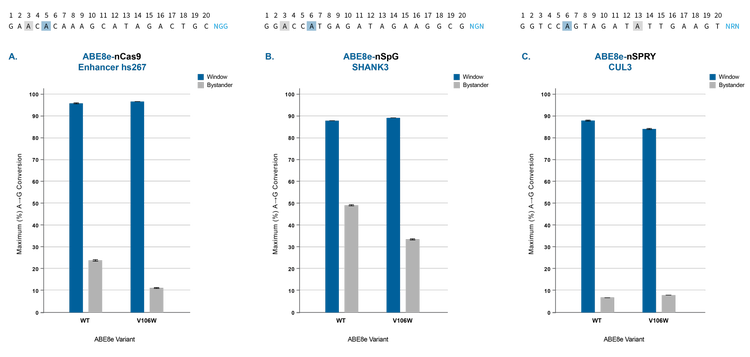
What is V106W? ABE8e V106W is a published adenine base editor variant1 designed to reduce bystander editing while maintaining strong on-target editing activity. It is well suited for applications where increased editing precision and a narrower editing profile are desired.
Product Details
Stocked Base Editor mRNAs
Aldevron offers six stocked adenine base editor (ABE) mRNAs available in 20 μg, 100 μg, and 1 mg formats.
| Product | PAM |
| WT ABE8e nCas9 | NGG |
| WT ABE8e nSpG | NGN |
| WT ABE8e nSPRY | NRN |
| ABE8e V106W nCas9 | NGG |
| ABE8e V106W nSpG | NGN |
| ABE8e V106W nSPRY | NRN |
Designed for Flexibility
- Wild type and high-specificity V106W variants1 available
- Multiple PAM options expand editable genomic regions
- Stocked mRNAs ship in as little as 1 business day
Integrated DNA Technologies’ (IDT) Alt-R™ Cas9 sgRNA XT
Optimized guide RNAs designed for mRNA- and LNP-based genome editing workflows.
Features
- Available from 2–100 nmol
- Desalt and HPLC purification options
- Increased 2'-O-methyl content for stabilization
- Designed specifically for mRNA and LNP delivery workflows
Not sure which editing approach is right for your application?
Compare base and prime editing to find the best fit
Product Data
On target vs bystander conversion of various ABE editors in HEK293 cells
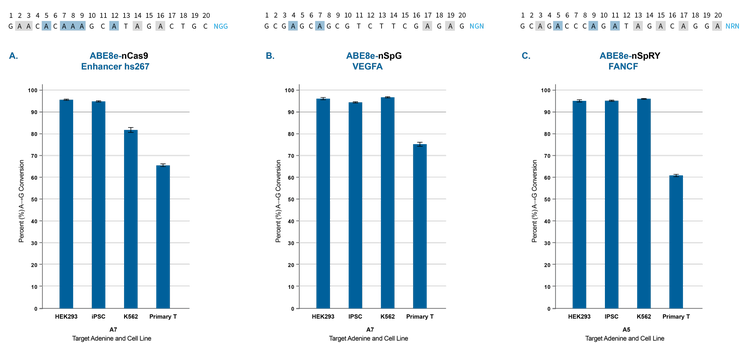
Base conversion efficiency across various immortal and primary cell lines
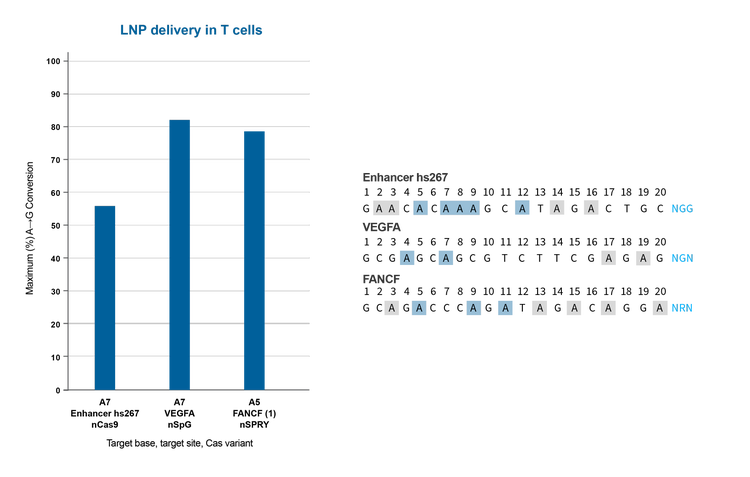
ABE conversion efficiency in Primary T cells via LNP delivery
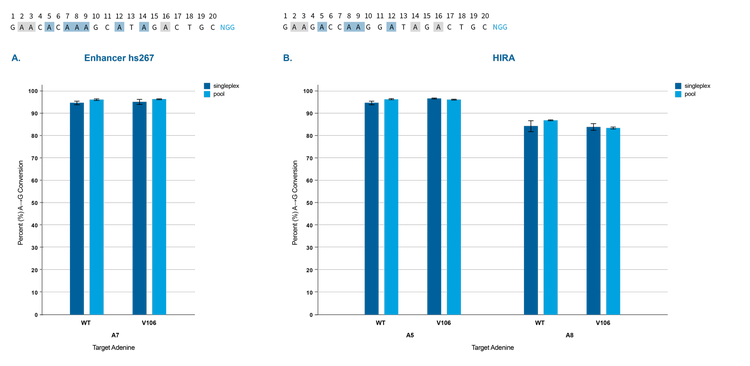
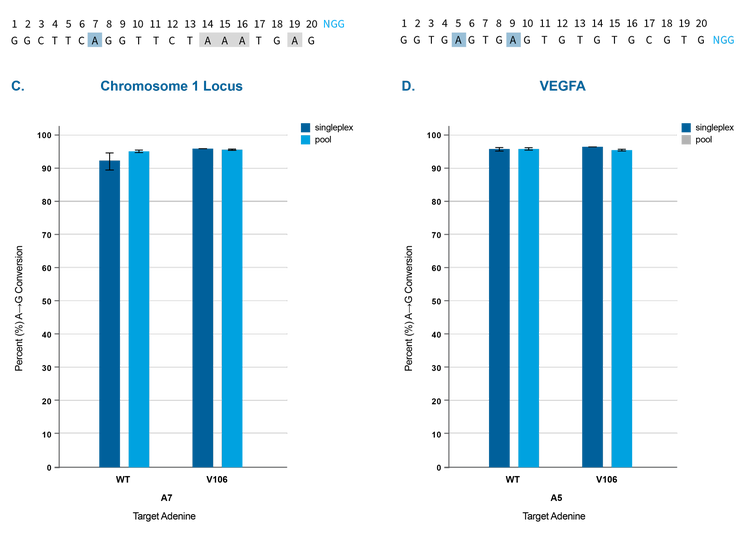
Target base conversion efficiency under singleplex or multiplex conditions
Frequently Asked Questions
The editor enables A-to-G•C base conversion without generating double-stranded DNA breaks.
Depending on your workflow, additional reagents for delivery and downstream analysis may also be required. Cas9 gRNA can be purchased from IDT.
In many applications, it reduces bystander editing while maintaining robust on-target editing activity, making it a useful option when precise editing outcomes are desired.
Prime editing may be a better choice when precise sequence changes are required, such as edits that cannot be achieved with base editing or applications where bystander edits are not acceptable.
Need Help?
Have questions for our CRISPR experts or need a custom solution? Your time is valuable and we’ll prioritize your inquiry. Fill out the form to provide brief information about your project, and we’ll be in touch to discuss it as soon as possible.
References
- Gaudelli et al. (2020), Directed evolution of adenine base editors with increased activity and therapeutic application (Nature Biotechnology).