
Nanoplasmid™ Vector Design/Retrofit
The Power of a Small Backbone for Gene & Cell Therapies
Nanoplasmid™ vectors are easily substituted for conventional plasmids, minicircles, Doggybone™ DNA, etc., for use with all major downstream vector technologies. The Nanoplasmid backbone was modified to remove bacterial coding sequences, uses an antibiotic-free selection system, and has profound beneficial effects on performance across a range of gene, cell, and mRNA therapies and vaccines including:
- Higher Transgene Expression and Duration
- Increases Plasmid DNA Manufacturing Yields
- Improves Safety Profile by Eliminating Antibiotic Resistant Gene
- Saves Time and Costs
Nanoplasmid Retrofit & Design Services
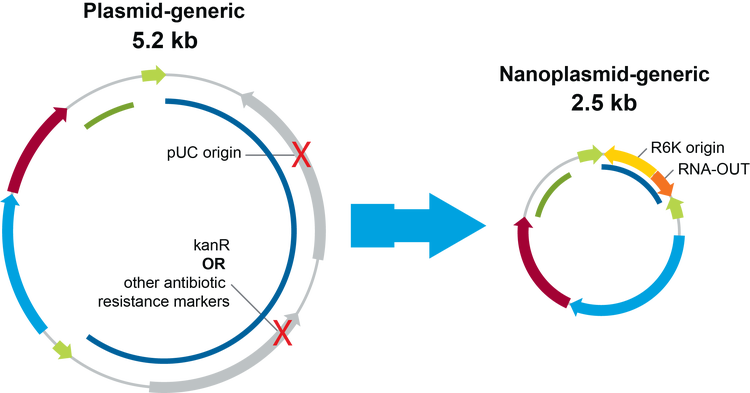
Our Nanoplasmid experts will work with you to either design a Nanoplasmid vector from scratch or retrofit an existing, traditional plasmid into a high-performing Nanoplasmid vector alternative, including sequence verification and DNA production. A retrofit entails sending us 10 micrograms of your plasmid (on filter paper or in liquid form). We will swap your current plasmid backbone for the Nanoplasmid version, verify the construct, and return the desired quantity of the amplified product.
Nanoplasmid Manufacturing
Nanoplasmid vectors combine the improved performance of minicircles with the manufacturing attributes of traditional plasmids. Therefore, our custom plasmid DNA manufacturing services are available for both Nanoplasmid vectors and traditional plasmids.

|
Dr. Tyler Kozisek is a Senior Scientist II in R&D at Aldevron, where he leads the Nanoplasmid design team. With a bachelor's degree in mechanical engineering and a Ph.D. in biomedical engineering from the University of Nebraska–Lincoln, Dr. Kozisek brings a multidisciplinary approach to plasmid engineering. His doctoral research focused on optimizing nonviral gene delivery methods and plasmid design to enhance transfection efficiency in primary human mesenchymal stem cells. Today, he applies that expertise to advance the development of next-generation plasmid technologies, driving innovation in gene therapy and cell engineering. |
Nanoplasmid is a disruptive technology in the clinical and pre-clinical arena. There have been dozens of publications showing off how this small backbone delivers powerful benefits.
- Boye C, Arpag S, Burcus N, Lundberg C, DeClemente S, Heller R, Francis M, Bulysheva A. Cardioporation enhances myocardial gene expression in rat heart. Bioelectrochemistry. 2021 Dec;142:107892. doi: 10.1016/j.bioelechem.2021.107892. Epub 2021 Jul 27. PMID: 34371349.
Showing improved electroporation transfection methods in vivo and in vitro using Nanoplasmid versus conventional plasmids for naked DNA expression.
- Oh SA, Senger K, Madireddi S, Akhmetzyanova I, Ishizuka IE, Tarighat S, et al. High-efficiency nonviral CRISPR/cas9-mediated gene editing of human T cells using plasmid donor DNA. Journal of Experimental Medicine. 2022;219(5). https://doi.org/10.1084/jem.20211530
This publication showed improved CAR-T knock-in efficiency, reduced cell death, and an improved T cell phenotype for CAR-T cell therapies using Nanoplasmid compared to conventional plasmids and linear DNA as an HDR template.
- Bozza M, De Roia A, Correia MP, Berger A, Tuch A, Schmidt A, et al. A nonviral, nonintegrating DNA nanovector platform for the safe, rapid, and persistent manufacture of recombinant T cells. Science Advances. 2021;7(16). doi: 10.1126/sciadv.abf1333
This article discussed how Nanoplasmid was integrated into a rapid and novel manufacturing workflow for the production of CAR-T cell therapies for patients.
For more information on these and other applications, download the complete bibliography.