
Webinar: Enhancing Gene Editing Outcomes and Safety for Clinical Translation with Next‑Generation Nanoplasmid™ Vectors
Get access today!
| region | na1 |
| portalId | 1769030 |
| formId | 7dfe7f53-904c-47ef-83d9-6e7fdda3dbbb |
| target | services-hubspot-form |
| redirectUrl | https://www.aldevron.com/thank-you/on-demand-enhancing-gene-editing-outcomes-and-safety |
How Nanoplasmid™ vectors can improve gene editing performance, safety, and translational readiness
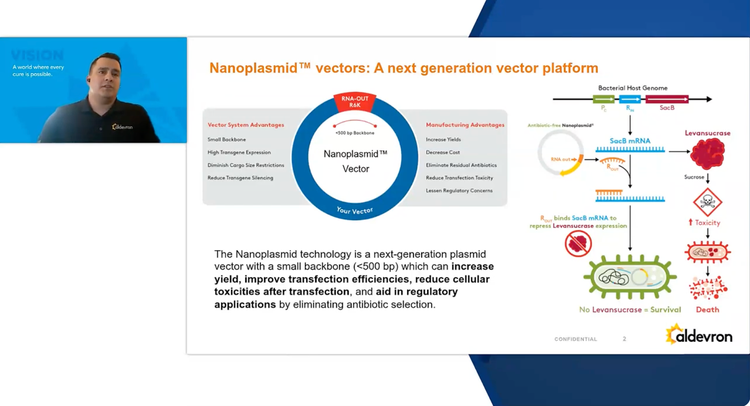
Plasmid DNA remains a critical enabling technology for gene editing, serving as donor templates for ex vivo and in vivo therapeutic platforms. However, conventional plasmids—often incorporating large bacterial backbones and antibiotic resistance markers—can negatively impact editing efficiency, durability of expression, and cellular health, with downstream implications for translational performance and manufacturability.
Nanoplasmid vectors, which feature a minimal, antibiotic‑free backbone, are designed to address these limitations by supporting higher and more sustained transgene expression while reducing transfection-related toxicity and transgene silencing.
In this webinar, we covered the following:
- Overview of Nanoplasmid technology and its design principles for gene editing applications
- Advantages of Nanoplasmid vectors, including improved editing outcomes, enhanced cell viability, and reduced transgene silencing
- Real‑world case examples from recent publications demonstrating improved translational relevance
- How Nanoplasmid vectors can help de‑risk preclinical development and accelerate progression toward clinical gene editing therapies
Speakers:
Dr. Tyler Kozisek, Senior Scientist II
Dr. Tyler Kozisek is a Senior Scientist II in R&D at Aldevron, where he leads the Nanoplasmid design team. With a bachelor's degree in mechanical engineering and a Ph.D. in biomedical engineering from the University of Nebraska–Lincoln, Dr. Kozisek brings a multidisciplinary approach to plasmid engineering. His doctoral research focused on optimizing nonviral gene delivery methods and plasmid design to enhance transfection efficiency in primary human mesenchymal stem cells. Today, he applies that expertise to advance the development of next-generation plasmid technologies, driving innovation in gene therapy and cell engineering.
Charissa Quinlan, Senior Director, Product Management – Nanoplasmid DNA
Charissa Quinlan is Senior Director of Product Management at Aldevron, where she leads the Nanoplasmid technology to support scalable, GMP-ready development and clinical translation of next generation therapeutics. She has deep expertise leading project, program, and strategic account management teams that drive client success through partnership from discovery through commercialization. Charissa holds her MBA from the University of North Dakota, and MS from the University of Notre Dame where she engineered targeted LNPs.