
Cas9 mRNA for Genome Editing

High-efficiency, low-toxicity mRNA formats for CRISPR-based applications

Wild type and 𝘚𝘱𝘺Fi™ high-fidelity mRNA formats for research grade genome editing

Aldevron, in partnership with IDT, offers Cas9 mRNA products designed to meet the demands of modern genome editing workflows.

Our Cas9 mRNA has been optimized to provide high editing efficiency with minimal toxicity. Both wild type and high-fidelity SpyFi variants are available, reducing the risk of off-target editing and supporting precision genome engineering.

We provide continuity from discovery to translational therapeutic development.

With a proven track record from development to cGMP, Aldevron serves as your technical consultant, offering robust, cost-effective solutions.

Performance Highlights

Available Formats (Research Grade Only)

Item No Description Purchase Option
3850-0020 SpCas9 mRNA, RG, 20 µg Buy Now
3850-0100 SpCas9 mRNA, RG, 100 µg Buy Now
3850-1 SpCas9 mRNA, RG, 1 mg Buy Now
3851-0020 𝘚𝘱𝘺Fi Cas9 mRNA, RG, 20 µg Buy Now
3851-0100 𝘚𝘱𝘺Fi Cas9 mRNA, RG, 100 µg Buy Now
3851-1 𝘚𝘱𝘺Fi Cas9 mRNA, RG, 1 mg Buy Now
Looking for cGMP versions of Cas9 mRNA? Contact us directly by filling out the form and a member of our team will reach out to you.

Product Data

On- and Off-Target Editing

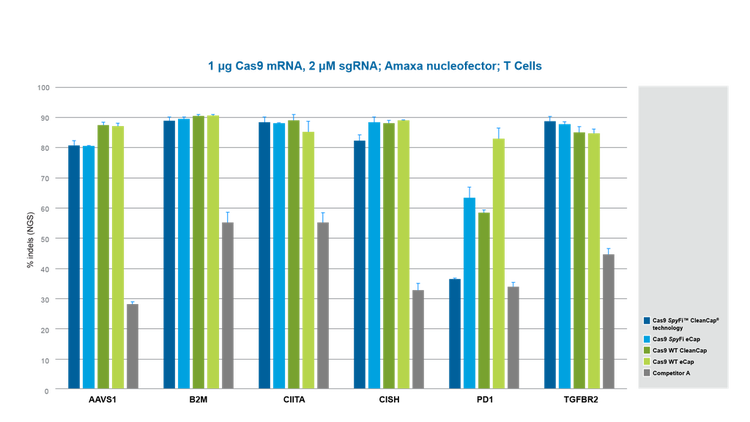
A. On-Target Editing at Clinical Sites; 1 µg mRNA
B. On- and Off-Target Editing at HBB; 1µg Cas9 mRNA
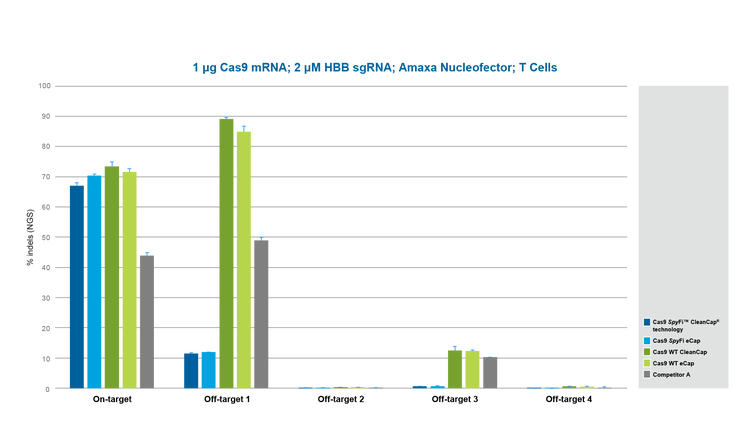
Figure 1: A. On-target editing at clinically relevant sites. Primary T Cells were thawed and activated 72 hours prior to nucleofection. 1 µg of Cas9 mRNA and 2 µM sgRNA targeting AAVS1, B2M, CIITA, CISH, PD1 and TGFBR2 were delivered by nucleofection into T Cells using the Lonza Nucleofection™ System. Genomic DNA (gDNA) was extracted 72 hours post nucleofection and editing was assessed by Next Generation Sequencing. B. On- and off-target editing at HBB. 1 µg of Cas9 mRNA and 2 µM sgRNA targeting HBB was delivered by nucleofection into T Cells using the Lonza Nucleofection System. gDNA was extracted 72 hours post nucleofection and editing was assessed by Next Generation Sequencing.

On- and Off-Target Editing in Immortalized Mammalian Cells

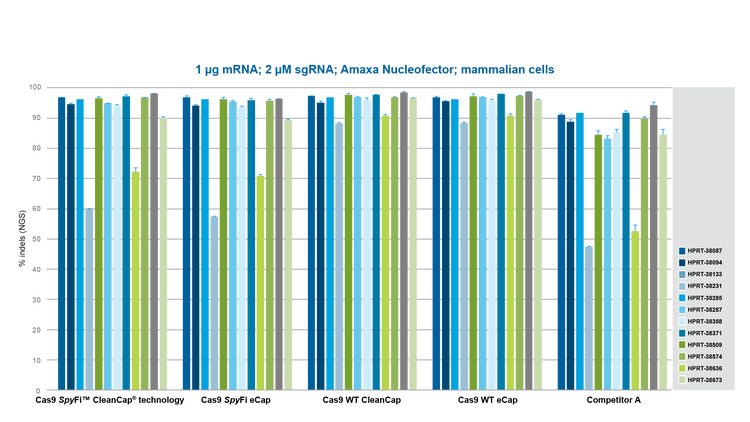
A. On-Target Editing at HPRT; 1 µg of Cas9 mRNA
B. On- and Off-Target Editing at EMX1 site; 1 µg Cas9 mRNA
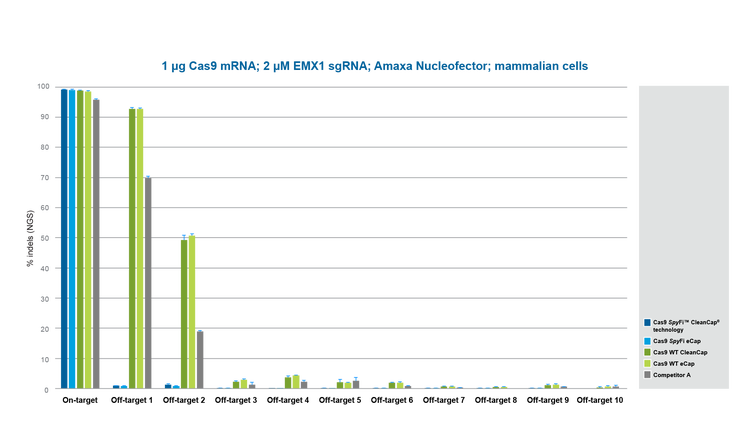
Figure 2: On- and off-target editing in immortalized mammalian cells. A. 1 µg of Cas9 mRNA and 2 µM sgRNA targeting 12 sites in the HPRT locus were delivered by nucleofection into mammalian cells using the Lonza Nucleofection System. Genomic DNA (gDNA) was extracted 72 hours post nucleofection and editing was assessed by Next Generation Sequencing. B. 1 µg of Cas9 mRNA and 2 µM sgRNA targeting EMX1 was delivered by nucleofection into mammalian cells using the Lonza Nucleofection System. gDNA was extracted 72 hours post nucleofection and editing was assessed by Next Generation Sequencing.

IFN Responses Generated

IFN Response Generated by THP-1 Dual Cells Transfected with Modified and Unmodified Cas9 mRNA
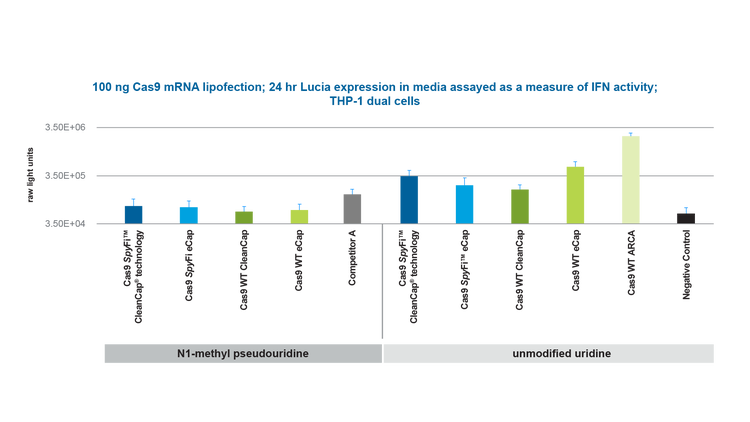
Figure 3. IFN Response generated by THP-1 dual cells transfected with modified and unmodified Cas9 mRNAs. THP-1 dual cells were transfected in sextuplicate with 100 ng of the indicated mRNAs complexed with 1 µL transfection reagent Lipofectamine™ MessengerMAX™. After 24 hours, Lucia expression in the media was assayed as a measure of IFN activity.

LNP Delivery

LNP Delivery of Cas9 mRNA, TRAC sgRNA – T Cell Receptor Knockout
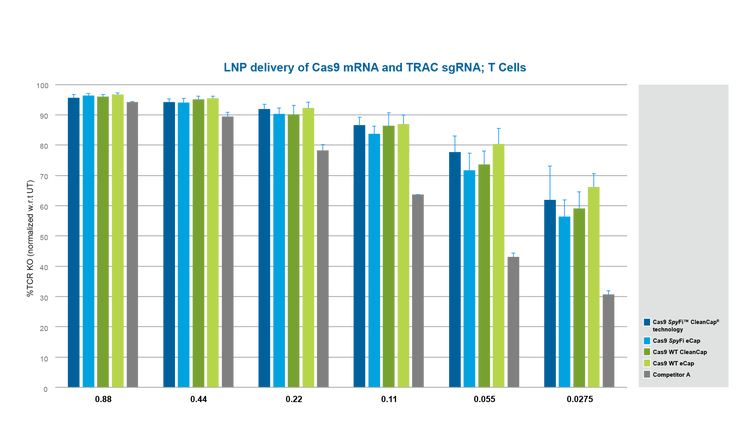
Figure 4. T-Cell Receptor knockout in T-Cells by LNP delivery of Cas9 mRNA and synthetic TRAC-targeting sgRNA. Cas9 mRNA and synthetic TRAC sgRNA were encapsulated into lipid nanoparticles (LNP) using the Genvoy-ILM™ T Cell Kit on the NanoAssemblr™ Ignite instrument, following manufacturer’s instructions. Briefly, RNA working solutions were prepared in the supplied formulation buffer, and Cas9 mRNA or sgRNA were individually loaded into LNPs. The lipid phase and mRNA phase were combined in the Ignite instrument and downstream processed as recommended in the instructions. Primary T Cells were thawed and activated 72 hours prior to LNP addition. Cells were seeded at 0.1 x 10⁶ cells/mL in serum-free media. Cas9 mRNA-LNPs and sgRNA-LNPS were mixed 1:1 by RNA weight and added directly to activated T Cells on Day 3. TCR knockout efficiency was assessed on Day 4 by flow cytometry after live-dead discrimination.

Delivery Compatibility

Cas9 mRNA formats are compatible with:

Frequently Asked Questions

How should Cas9 mRNA be stored?
We recommend storage of Cas9 mRNA at -80°C.
What is the concentration of Cas9 mRNA and which buffer is it supplied in?
Cas9 mRNA is provided at 1 mg/mL in 1mM sodium citrate, pH 6.4.
What is the difference between enzymatic capping and CleanCap® mRNA capping?
CleanCap® technology is a patented mRNA capping technology developed by TriLink BioTechnologies that facilitates co-transcriptional capping of mRNA during in vitro transcription. Enzymatic capping is a post-transcriptional process during which the mRNA undergoes a series of enzymatic reactions.
What delivery method is recommended for Cas9 mRNA?
The best delivery method for Cas9 mRNA depends on the application. For tissue culture experiments, we recommend electroporation. Cas9 mRNA delivery is also compatible with lipid nanoparticle (LNP) delivery and microinjection.
Does Cas9 mRNA include a 5' cap structure, poly(A) tail, untranslated regions (UTRs), and a nuclear localization signal (NLS)?
Cas9 mRNA features a Cap-1 structure at its 5’ end and includes both 5’ and 3’ untranslated regions (UTRs), a polyadenylated (poly(A)) tail of at least 100 nucleotides, contains N- and C-terminal NLS sequences, and is chemically modified with N1-Methylpseudouridine.
What is N1-Methylpseudouridine, and why is it incorporated into Cas9 mRNA?
N1-Methylpseudouridine is a modified uridine nucleoside which reduces immunogenicity while simultaneously increasing translational capacity and stability.
What species-specific Cas9 does the mRNA code for?
Our Cas9 mRNA product encodes Cas9 from Streptococcus pyogenes (Sp).

Ready to Learn More?

Contact us to explore how Aldevron’s Cas9 mRNA formats can support your genome editing program.

CleanCap® is a registered trademark of TriLink BioTechnologies LLC.